
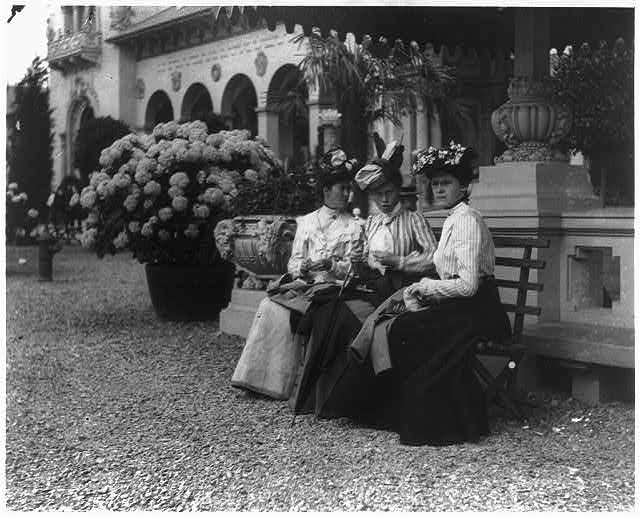

It’s about time we talked about the Pan American Exposition, of course held here in Buffalo from May 1 – Nov. 3, 1901. Thousands upon thousands of people flocked to the grounds during that time to see the buildings and shows, eat at the restaurants, and stroll along the midway.
And the women of Buffalo – at least the influential and well-connected ones – had a say in the planning.

Board of Women Managers

Mrs. William Hamlin, president of the board and chairman of the executive committee, sites in the immediate foreground. On her right is Miss Marian DeForest, the secretary of the board. Next to Miss DeForest is Mrs. John Miller Horton, then come Mrs. Charles Cary, Mrs. Tracy C. Becker and Mrs. Adelbert Moot Mrs. Alfred G. Hauenstein, and Dr. Ida C. Bender, who is nearest to Mrs. Hamlin on the left.” So read the original caption, from The Illustrated Buffalo Express, Sept. 23, 1900.
In 1900, a group of well-known and very active Buffalo women came together to plan art displays, educational programming, and much more.
Officers: Mrs. William Hamlin, president; Mrs. William Rogers, vice president; and Marian DeForest, secretary.
Committee chairs: Mrs. Charles Cary, Fine Arts; Mrs. John M. Horton, Entertainment & Ceremonies; Mrs. Albert Hauenstein, Publicity & Promotion; Mrs. Tracy Becker, Applied Arts; Mrs. Adelbert Moot, Clubs & Organizations; and Dr. Ida Bender, Education.
Board members: Mrs. Joseph Desbecker, Mrs. Elizabeth McGowan, Mrs. Joseph Gavin, Mrs. George Townsend, Mrs. Herman Mynter, Annie Damer, Mrs. Herman Waterman, Mrs. Lester Wheeler, Mrs. Norman Mack, Mrs. David Gray, Frances Stanton, Mrs. Robert Root, Mrs. J. F. Schoellkopf Jr., Mrs. John Bush, Mrs. Charles Kingsley; Mrs. J. J. Albright, and Mrs. P. H. Griffin.

‘Peeps at the Pan Am’
Mabel Barnes, a 24-year-old Buffalo schoolteacher, visited the Pan-Am 33 times, saving souvenirs, newspaper clippings, ephemera, and other mementoes. Over the next 14 years, she pasted everything into three scrapbooks containing more than 600 pages, which she called “Peeps at the Pan Am.” She also added detailed notes about the people and things she saw during her many visits.

The Lady Architect

Boston architect Josephine Wright Chapman won the highly competitive design contest for the New England States Building. When she found out that the New England Commission, comprised of governors of all six New England states, was to meet in Boston on a certain date, Chapman showed up with her design and her pitch. The next morning she got the commission.

A Woman’s Touch

Adelaide Thorpe, from New York, beat 300 other entries to win the competition to design the Pan-Am’s official flag, featuring the national symbols of the participating countries along with a gold eagle and green banner bearing the words “Pax (peace) 1901.”

A textiles specialist, she was named Assistant Director of Interior Decoration, and oversaw flag, bunting, and drapery decorations in the various buildings. She had worked with C. Y. Turner, the Exposition’s color designer, for several years prior. She even traveled to the 1900 Paris Exposition to study the interior design of those buildings.


‘The Doll Lady’

“The Doll Lady of the Midway,” stood only 26 inches high, welcoming visitors into her tiny parlor. Her real name was Espiridiona “Alice” Cenda, and she came from Mexico, not Cuba as advertised. She also sang and spoke seven languages.

She was managed by Frank Bostock, “The Animal King,” who also managed the PanAm’s animal arena. Chiquita, who was in her 30s, fell in love with 16-year-old Tony Woeckner of Erie, Pa., one of Bostock’s workers, and on the night of Nov. 1, 1901, the two of them eloped. Bostock was furious, and a lengthy legal battle ensued between him and Woeckner. Alice and Tony eventually prevailed and lived together until her death in 1928.
‘Spirit of Niagara’ and ‘Rainy Daisy’

Local artist Evelyn Rumsey Cary’s poster design was a gold-accented lithograph in nine colors. More than 1.5 million copies were distributed around the world, and Exposition officials received daily requests for copies. However, acclaim was not universal. The Providence, R.I. city schools banned it. A reporter for the Providence Journal suggested Providence residents would be happier seeing a woman wearing a cost and boots. Pan-Am artist Chris Muegel designed “Rainy Daisy” in response, and his sketch appeared in The Buffalo Illustrated Express and the New York World.


‘The Faces of the Pan Am’

As event planning began, Pan-Am officials wondered how they were going to find women to model for North America and South America on the official emblem. The New York World launched a contest, and thousands of photos poured into its offices from around the country.
Well-known New York actress Maxine Elliott was selected for South America. Maude Coleman Woods of Virginia, characterized by newspapers as “the beautiful Virginia blonde,” portrayed North America.
Elliott was friends with many of the era’s wealthiest and most prominent men, including J.P. Morgan and Kind Edward VII. She owned her own theater in NYC – The Maxine Elliott on 39th Street – and had made quite a bit of money for herself by the time she retired from acting in 1920.


Woods had been photographed for a pamphlet called “The Rosebud Garden of Girls” for a reunion of Confederate generals. New York photographer Alexander Black photographed her for his book, “Miss America: Pen and Camera Sketches of the American Girl.” Woods’ father agreed, and she appeared in the book (see p. 108) anonymously, as did all the other young women and girls featured.
Without Woods’ consent or knowledge, Black submitted her photos to the Pan-Am emblem contest.
Woods was a gentile Southern young woman. Although publicly saying she was pleased for the honor her selection bestowed upon Virginia, personally she took no pride in it. She was horrified by the attention she received. She fled to her family’s summer home with her mother and sisters, where she contracted typhoid fever and died one day before her 24th birthday.

Carving Out a Name for Herself
Gertrude Vanderbilt Whitney’s life-size plaster sculpture of a male nude figure, entitled “Aspiration,” stood on display in front of the New York State Building – the only Expo building designed to be permanent. It became The Buffalo History Museum.

Whitney was the second daughter of Cornelius Vanderbilt II and Alice Claypoole Gwynne, and a great-grand-daughter of the legendary tycoon “Commodore” Cornelius Vanderbilt. Her family frowned upon her choice of career, but she perseevered, even gaining the support of legendary sculptor Auguste Rodin. She was commissioned to create the Pan Am work, and she did so under an assumed name at first.

What became of the statue? No one knows.
Angels in White
The expo’s emergency hospital was designed under the direction of Roswell Park, M.D. and operated just inside the West Amherst Street Gate for quick access to local hospitals. Nurses were recruited for one-month tours of duty via fliers sent to hospitals across the northeast. They were paid only an honorarium to cover travel and laundry. During their off-duty hours, they were free to explore the Exposition.

As did many other groups, the International Council of Nurses held its annual meeting in Buffalo that year, Sept. 18-21. Throughout the event, several women presented papers and reports about nursing, hospital work, etc. from around the world.

Pan Am Melodies
Many songs were written about the event, from marches to waltzes, two-steps, a cake walk, and even one dedicated to Chiquita, called “The Lilliputian Queen.”
A few were even written by women:

A Place for Women to Rest
The Board of Women Managers appropriated the Buffalo Country Club building, just inside the gate and overlooking the park lake. It even had a “fainting room,” painted dark green with lilies of the valley in the wallpaper.

Pan Am Fashion
Florence Shave of Corry, Pa. showed her excitement for the Pan-Am Expo by designing and wearing this outfit for a masquerade.

Visitors to the Pan Am’s glass factory could catch a glimpse of this spun glass dress, modeled on a mannequin made to look like New York actress Maxine Elliott. (You’ll remember her as the model for South America on the event logo.)

Here’s proof that women have always been judged by what they wear:


DIY Souvenir
One of the most unique Pan Am souvenirs was one women made themselves! They could buy a block for a penny – including sewing floss – or a pack of 50 for 50 cents, and assemble the squares as a memento of their visit. Each square depicted something from the Pan Am, including the various buildings and exhibits.

Famous Female Visitors
Calamity Jane (Martha Jane Burke)
Exposition officials wanted her as a midway attraction, so they hired Buffalo novelist and newspaperwoman Josephine Brake to find her. She found Burke ill and nearly destitute in a house of ill repute in Montana and brought her to Buffalo to perform with the Indian Congress. She enjoyed a private trolley car ride to Niagara Falls, and that evening Brake hosted a dinner for her at the Iroquois Hotel. Burke stayed in Brake’s home for several weeks, but they had a falling out and Burke went to stay with the Indian Congress. On July 30, riding a wagon, she drove a team of between 60-100 mules up Main Street as part of the Elks Day Parade. She also found some mischief while in the Queen City; she was arrested twice for public intoxication – once in Buffalo once in North Tonawanda.

Susan B. Anthony, Carrie Chapman Catt and Rev. Anna Shaw
Like many other national groups, the National Woman Suffrage Association held its annual meeting in Buffalo in 1901 to coincide with the Pan-Am. Many of the events took place Sept. 9-13 at the convention hall at the corner of Elmwood and Virginia. Catt presided over the activities. On Sept. 12 at the Temple of Music on the Pan-Am grounds, Shaw and Anthony spoke. Anthony and Shaw were back in Buffalo the following October for the New York State Woman Suffrage Association annual meeting.

Annie Oakley
The famed sharpshooter came to town as part of “Buffalo Bill’s Wild West and Rough Riders of the World” show, in an enclosure just outside the East Amherst Street gate.

The show featured “races, wild real races, in which the horses did their best.” Oakley came out after all the horseman paraded around the area, “giving her usual fine exhibition and then came some feats of horsemanship which were interesting to say the least,” wrote one reporter:

Later that year, around Thanksgiving, Oakley refereed a “50 live bird match” shooting match at Audubon Park between Otto Besser and “Bob” Hawkins. She was expected “to give an exhibition of fancy shooting” following the match, according to the Nov. 27, 1901 Buffalo Evening News’ front page article.

Links & Learn More
Minutes of the Board of Women Managers
“Doing the Pan,” the website created in 2001 (the Pan Am’s centennial) by the late Susan J. Eck
Pan Am sheet music collection, online via the Buffalo & Erie County Public Library
Glass dress, stereoscope image in NYPL’s digital collections
Pan Am scrapbooks in The Grosvenor Room, Central Library

Author’s Note
Mary B. Talbert played a critical role in improving the image of African American people at the exposition. She protested Midway attractions “The Old Plantation” and “Darkest Africa, which drew on racial stereotypes and caricatures of black peoples. She also fought to include “The Negro Exhibit,” which had been used at the 1900 World’s Fair in Paris. Please see her profile on this site for more information.